THE milestone of the 70th anniversary of the 1956 Women’s March was observed with a thought-provoking debate on women’s liberation between the South African Debating Team and the Soweto Debating Academy at the Apartheid Museum.
Talk Radio 702 broadcaster Bongani Bingwa moderated the debate which tackled the motion: “Do we prioritize economic empowerment over political representation as the key to women’s liberation?” – pending a programme which also featured a panel discussion between Deputy Public Protector, Advocate Dinkie Dube and the Gauteng MEC for Economic Development Vuyiswa Ramokgopa.
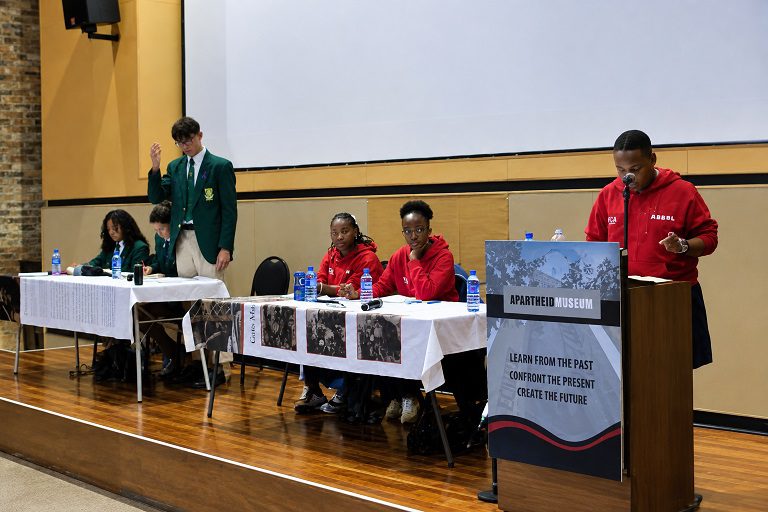
An intellectual tussle betwixt high school students, SADT comprised of the trio of Adrian Etzinger, Kimiya Ghaheri and Lucy Blades – who appeared resplendent in green blazers emblazoned with the national protea emblem – while SDA was represented by Ntando Thebe, Zamazizi Mthanti and Karabo Mofokeng.
Among the eclectic mix of attendees, who mostly comprised schoolgirls as well as the afore-mentioned MEC and DPP, was the City of Johannesburg Junior Mayor Ndivhuho Nthangeni and Johannesburg Student Council members.
After the viewing of a retrospective video documentary on part of South Africa’s history which also limned images from the mid-fifties protest led by Lillian Ngoyi, Sophia Williams-De Bruyn, Helen Joseph and Rahima Moosa, attendees – who had been requested to dress in black – were welcomed by both the museum’s manager Vinolia Hlagwana and the Junior Mayor, Nthangeni.
Thereafter, Bingwa, a self-confessed stickler and nerd for facts, got proceedings under way by regaling the audience with fascinating fact-files before the debating teams took to the stage – with the Soweto Debating Academy’s Ntando Thebe being first off the block.
Inter alia, the Soweto Debating Academy trio argued that political representation created conditions for economic empowerment to exist, expand and be protected, specifically for women.
In instances where women lacked jobs, income or businesses, parliamentary representatives ought to cater for them by taking up their cause – an SDA member reasoned while pointing out that political representation gives women collective power beyond the individual.
As the tussle between the two teams became animated, a juncture for the audience to ponder about occurred when the SDA’s Ntando Thebe declined SADT’s Adrian Etzinger’s request to object to a point. Even at a point at which multitudes of women are economically empowered successfully – who determines the conditions under which they live, enquired the SDA?
The framework of the SDA’s proposition was that economic empowerment is the depth of a woman’s pocket.
The South African Debating Team’s proposition on the other side was in support of the motion that economic empowerment is more important than political empowerment in liberating women.
The team demonstrated how women were more safe when they’re economically free from things like abusive relationships and how money brought choices for them in the first place.
Second of all, even if women didn’t get money, they still benefited from a secondary impact in the form of donations towards charitable causes in support of their liberation – suggested the SADT.
The team’s perspective further reckoned that more money towards women shelters supported by women culminated in them benefitting.
SADT’s Kimiya Ghaheri’s speech argued that you fix the perception of women as being weak and inferior when you put them in a capitalistic world of power, i.e., when they become CEOs.
The script is flipped when women are powerful and strong as expressed through occupations such as becoming doctors instead of nurses and professors instead of primary schoolteachers.
The SADT also changed the whole narrative about women being seen as weak and inferior.
Subsequent to the young teams’ turns on the stage followed an insightful colloquium between the Deputy Public Protector and the Member of the Executive Council – who wasted no time in delving into the gist of the topic in question.
In encapsulating some of MEC Vuyiswa Ramokgopa’s salient points, she pointed out that even if women represented 55% of South Africa’s voting bloc, “political representation doesn’t translate to political power,” – further stating that “you cannot secure economic power without political framework.”
Mentioning that forty to fifty years ago, women weren’t allowed to own property in the country, Ramokgopa ventured that “women aren’t dormant – but are active.”
Advocate Dinkie Dube, the Deputy Public Protector meanwhile railed against women public office bearers who abused their power, as she declared that “women must no longer see themselves as victims.”
She rounded off her points of discussion by proposing that: the question oughtn’t be how do you get to the table – rather, what do you do once you are there?
At the conclusion of the lively programme, both debating teams were issued with certificates of participation as well as gifts.
The debate formed part of the museum’s ongoing programming around the 70th anniversary of the August 9, 1956 march – thus creating an opportunity for young people to engage with the legacy of women’s political activism while considering the challenges and priorities of women’s liberation today.
Image Jacob MAWELA (A South African Debate Team’s Adrian Etzinger limned raising his hand in objection while a Soweto Debating Academy member spoke during the Young Debaters’ session at the Apartheid Museum.)