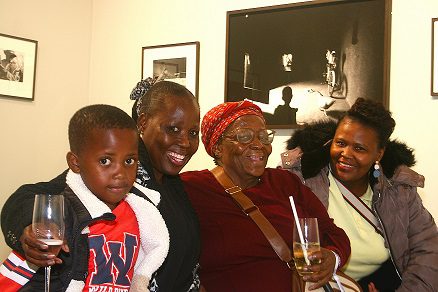
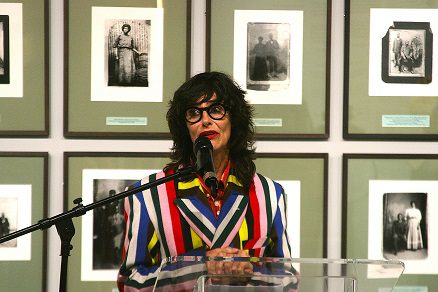
THE Thursday evening of April 23 witnessed Joburg’s artset flocking to the upmarket Standard Bank Art Lab at Nelson Mandela Square in Sandton for the VIP preview of late photographer Santu Mofokeng’s exhibition, Rumours /2026.
Co-curated by Lunetta Bartz on behalf of the Santu Mofokeng Foundation, according to information gleaned from a media release issued by the corporate behemoth’s content bloc initiator, the display brings together three bodies of work drawn from Mofokeng’s extended engagement with the North West Province dorpie of Bloemhof and its surrounding communities between 1988 and 1994.
First shown in 1994 as Rumours / The Bloemhof Portfolio, the visual display makes a comeback as a presentation repositioned for a present which continues to navigate conditions it depicts. The release further hints that its title gestures toward the ways in which knowledge moves: laterally, informally, and often without resolution.
It reflects Mofokeng’s own method, one grounded in proximity, in trust, in the time required to see without imposing. What emerges is not a singular narrative, but a field of relations shaped by memory, labour, intimacy, and belief.
At the centre of the exhibition is The Black Photo Album / Look at Me: 1890–1950, a body of work composed of studio portraits collected by Mofokeng over many years.
Commissioned by Black working and middle-class families, these images exist outside of official archives. They were made for interiors, for private circulation, for the spaces where life is held rather than displayed.
In gathering, retouching, and re-presenting them, Mofokeng does not claim authorship.
Instead, he reframes them, asking what it means to encounter images that were never intended for public view, and what it means to look within an archive that resists containment.
Alongside the afore-mentioned body of work, the other presentation, viz, Concert at Sewefontein, traces a moment of collective release. Photographed during a gathering of farmworkers and tenant labourers, the images move through low light and motion, bodies folding into one another, time loosening its edges. What appears is not documentation alone, but an atmosphere, a way of being together that exceeds the frame.
A further documentation named Labour Tenancies anchors the exhibition in the textures of everyday life.
Produced during Mofokeng’s research with tenant farming communities, these photographs hold the contradictions of place: intimacy and distance, familiarity and estrangement. They resist simplification, insisting instead on the complexity of lives shaped within, but not reducible to, the structures of apartheid.
Across these works, Mofokeng’s practice unsettles the expectations of documentary photography. Rather than producing images of spectacle or crisis, he turns toward what is often overlooked: the spiritual, the domestic, the quietly constructed self.
His photographs move between what is seen and what remains withheld, between presence and absence, evidence and projection.
According to Dr Same Mdluli, the Gallery Manager at the Standard Bank Art Gallery in the Johannesburg CBD, as well as the show’s co-curator, Rumours /2026 brings viewers into proximity with the ways images live beyond their making.
She’s partly quoted thus: “In Santu Mofokeng’s work, we encounter photography not as a fixed record, but as a space of relation where memory, imagination and lived experience converge.
This exhibition invites us to consider how images travel, what they carry and how they continue to return to us, asking to be read differently.”
In addition Bartz, who’s also the co-founder of The Santu Mofokeng Foundation, is mentioned in the media release stating that the exhibition offers the South African public the opportunity to appreciate a focused selection of some of Mofokeng’s most significant work.
Presented as part of the Standard Bank Art Lab’s commitment to engaging African artistic legacies as active frameworks, the exhibition situates Mofokeng’s work within a broader conversation about land, memory, and representation.
Rumours /2026 asks the viewer to look again, with care.
The preview, which preceded the actual public opening had the lensman’s family members in attendance along the current cohort of photographers such as Roger Ballen, Siphiwe Mhlambi, Andrew Tshabangu, Seopedi Motau, Neo Ntsoma – et al.
Rumours/2026 will be on display until October 18, 2026.
The exhibition is free for viewing by the public.
About Santu Mofokeng
Born in Johannesburg in 1956 and raised in Soweto, Santu Mofokeng developed a practice which consistently refused the limits placed on representation. From his early years’ as a street photographer, through his work with Afrapix, to his role as a researcher and artist, he remained attentive to the ways in which Black life was imaged, and mis-imaged, within South Africa.
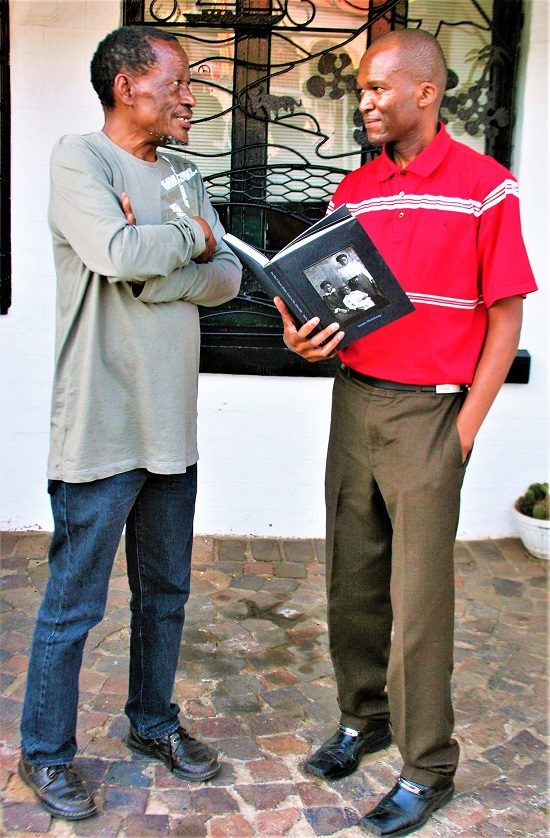
Mofokeng passed away on January 26, 2020 – having succumbed to a brain tumour, following a period of illness.
About the Santu Mofokeng Foundation
Santu Mofokeng formalised the Santu Mofokeng Foundation in 2015 after having being inspired by the Andy Warhol Foundation in Pittsburg, USA – with the express purpose of preserving his photographic legacy.
Since 2015, the foundation has been operating as per the photographer’s wishes regarding the preservation of his archive, as well as the administration of his copyright and the continued exhibiting and publishing of his work.
Author’s Reflection
As a fellow photographer who knew Mofokeng on a personal basis, the presence of Bartz and Mofokeng’s family in the same space prompted me to question the irony of a dispute over the foundation’s founding which came about on the back of litigation over control of the photographer’s archive.
A while back, Bartz got entangled with the family in a civil contractual litigation brought before a High Court regarding the transferring of Mofokeng’s archive to the foundation -on the legal claim that the photographer lacked mental capacity when signing the donation agreement which ceded his work from the executor of his estate, to the foundation.
The matter culminated in the High Court dismissing the application, with its ruling finding no proof that Mofokeng lacked mental capacity at the time, or that the contract ought to have been invalidated.
At the preview, I queried both Bartz and Mofokeng’s daughter, Thato Ramatlotlo concerning the dispute – with the former pointing out to the outcome of litigation and the latter being non-committal about her family’s lack of control over the precious archive.
Image Jacob MAWELA (Lunetta Bartz of the Santu Mofokeng Foundation limned during the VIP Preview of the late photographer’s exhibition, Rumours (which she co-curated), at the Standard Bank Art Lab in Sandton.)