“NATIONAL Treasury withheld the July equitable share transfers from 69 municipalities across all nine provinces.
It relied on section 216(2) of the Constitution, read with the Municipal Finance Management Act,” declared the MEC for Finance in Gauteng Province- Nkululeko Dunga.
He was in pains to explain that unfunded budgets, unresolved irregular and wasteful expenditure, weak consequence management, and unpaid debts to Eskom and water boards, were some of the reasons the province’s budget has decreased.
To worsen the situation, Treasury withheld the July equitable share transfers from 69 municipalities across all nine provinces. It relied on section 216(2) of the Constitution, read with the Municipal Finance Management Act.
Six of those municipalities are in Gauteng: Johannesburg, Emfuleni, Lesedi, Sedibeng, Merafong and Rand West.
“On 28 July, Treasury began releasing the money, but with conditions. By then, only 20 of the 69 had received their full allocation, 21 had received part, and 28 had received nothing. The December instalment can still be withheld if the conditions are not met.
Now the Minister has gone further. He has told Parliament that provinces owe municipalities about R14 billion, and he has warned that provincial equitable share will be withheld where departments do not pay municipalities within 30 days,” says MEC Dunga.
Dunga was interacting with media corps on the evening of Thursday 29 in Parktown, as part of providing feedback on shrinking cash reserves, municipalities poor performances, e-toll and Gauteng concession, unpaid/outstanding invoices, amongst others.
He also pointed out fingers at Health and Education departments for experiencing huge invoice bills.
Upon ascending to the position in April earlier this year, which will be exactly 6 months this Saturday, Dunga, says there was a total budget of R179.2 billion, facing six key pressures.
He mentioned the following:
First, the e-toll debt. Gauteng agreed to carry 30% of the SANRAL e-toll debt. Including interest, that is R20.1 billion, payable over five years. By the end of September 2026, we had paid R14.1 billion. The balance is R6.2 billion.
The next instalment of R3.3 billion is due on 30 June 2027, and the debt will be fully settled by June 2028.
On top of this, the province carries a DBSA loan with a remaining balance of R5.6 billion, payable until 2033. Together, these two debts stand at R11.75 billion.
Put plainly, this is money for a road the people of Gauteng never wanted to pay for, now competing with clinics, classrooms and housing.
Second, the Gautrain concession. The current concession comes to an end, and we had to familiarise ourselves with a major future commitment under very difficult conditions. Gautrain is a public asset. Whatever comes next must protect the public interest first, and we think that, this is what everyone has tried to achieve with the new concession.
Third, shrinking cash reserves. In the past, the province had money in the bank that gave it room to breathe. We are told how, at times, Gauteng could fund education before the equitable share arrived from national.
That room is gone. Cash and cash equivalents fell from R9.8 billion in March 2025 to R5.8 billion in March 2026. That is a drop of R4 billion in one year.
Fourth, declining revenue. Our own revenue fell by 15.9% last year, from R8.6 billion to R7.2 billion. Part of this is a sluggish economy.
Unemployment in Gauteng was 33.1% in 2025. Part of it is technology.
Gambling has moved online, while our law still taxes the casino floor. By August, the Department of Economic Development had collected only R343 million, or 23%, of its R1.46 billion target, because land-based gambling keeps declining.
And let us remember that 78.9% of our revenue, R139.1 billion last year, comes from the national equitable share.
We are a province that depends on transfers that are themselves under pressure.
Fifth, municipalities under enormous pressure. Rising debts, underfunded mandates and corruption.
Emfuleni has received a qualified audit for five years in a row. And the relationship cuts both ways. Municipalities collect motor vehicle licence fees on our behalf, but the amount they owe the province has grown from R2.9 billion to R3.3 billion.
Johannesburg, Ekurhuleni, Rand West and the Post Office are the biggest contributors.
Sixth, and most painful, the killing of public servants. There are increasing cases of officials, particularly those in finance and procurement, being assassinated.
People are being killed for doing their jobs honestly. This is an attack on the state itself, and it must be treated as such.
The financial year began, and it was soon followed by the finalisation of the audit, the end of the municipal financial year, and the work on the Gautrain concession.
We were also entrusted with the responsibility to facilitate and fast-track Public-Private Partnerships at EXCO level.
At the end of August, provincial departments owed Gauteng municipalities R2.7 billion for rates, taxes and services. After payments of R164 million that month, the balance came down to R2.5 billion.
Most of it is old. Of the debt that departments have confirmed, 78% is older than 90 days.
Infrastructure Development owes about R1 billion and Education about R981 million.
The City of Johannesburg alone is owed about R1.4 billion.
So here is what we have done:
- The Executive Council has approved the centralisation of the provincial budget for municipal rates and taxes under Provincial Treasury. We will control it, monitor it and pay it.
- We have verified provincial properties against Deeds Office records, so that we pay only for buildings the province actually owns.
- We are reviewing why municipalities charge business tariffs for schools and other public infrastructure.
- Together with COGTA, we have drafted protocols to resolve billing disputes on time. We workshopped them with municipalities on 14 October, and they go for approval by all accounting officers by the end of October.
- We have put in place an early warning system, so that accounts are flagged before they age into arrears.
When we held our first press conference in Soweto, together with the department, we set out our short- and medium-term priorities. Let me account against each.
Maximising revenue and finding new sources
Our own-revenue target for this year is R8.28 billion.
By the end of August we had collected R3.09 billion, or 37%. That is behind where we want to be, and we know why. So we are moving on several fronts. We are shifting casinos from a flat tax to a flexible rate of between 8% and 15%.
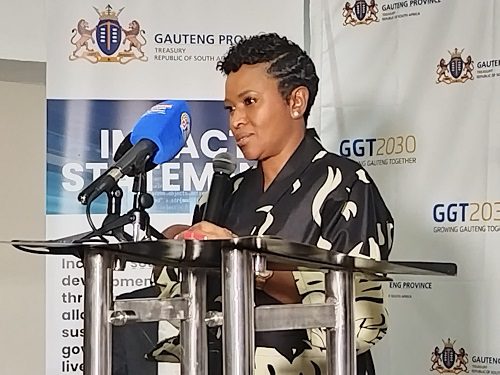
Gauteng Provincial Treasury –Head of Deaprtment, Ncumisa Mnyani remarked that accountability will create opportunities in the province since it constitute high number of unemployed youths.
MEC Dunga will present his Medium-Term Budget Policy Statement and the Adjustments Budget post the Local Government Elections to be held on November 4.
‘Coalition is the way’ he said, clinching his fist.
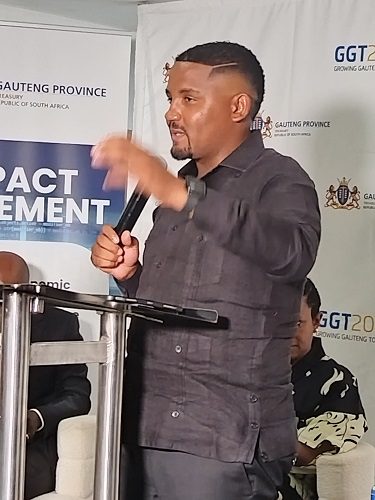
Image Mdu Mphahlele (Cash reserves in the province is shrinking, says the worried GP MEC for Finance Nkululeko Dunga, limned addressing media and guests in Parktown, on Thursday evening.)