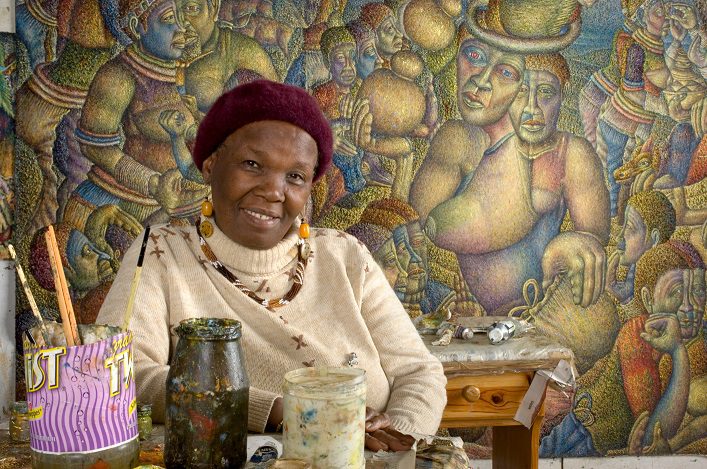
MMAKGABO Mmapula Helen Sebidi selected for the 61st International Art Exhibition of La Biennale di Venezia
Recently turned 83 Marapyane-born artist, Mmakgabo Helen Sebidi, has been invited to the 61st Venice Biennale (the global art world’s most prestigious exhibition for contemporary art) set to run across various locations of the waterlogged Italian city from May 9 to November 22, 2026.
One of South Africa’s most pre‑eminent artistic figures whose contribution spans decades, the North West Province-raised octogenarian has come full circle from setbacks which included surviving a car crash which claimed the life of one of her mentors in the 1980s – and the agony of her artworks disappearing for three decades in a foreign country, until they were recently recovered.
Having come under the tutelage of her first mentor, artist John Koenakeefe Mohl, in the early 1970s, Sebidi would make the news headlines for a heartbreaking reason when she’d lose a second mentor in the person of the then Johannesburg Art Foundation head, Bill Ainslie, in a car crash in which herself and fellow artist David Koloane sustained serious injuries on August 26, 1989.
The trio had been travelling back from a workshop in Matabeleland, Zimbabwe and Sebidi was airlifted to Baragwanath Hospital where she would spend over a month convalescing. (In a 2024 interview with curator, writer, researcher and artist, Riason Naidoo, Sebidi recalls the doctors there enquiring, “Who are you? Why do you come with a helicopter? Are you the wife of an ambassador or the wife of a king?”)
She mentioned that she was later regarded as a threat by the doctors who thought she was a political activist. She claims that voices told her she was in danger there and needed to get out of the hospital – an answer which manifested itself through a timely call to Dr. Nthato Motlana which led to him having her transferred to Lesedi Clinic, with the private health facility’s founder confiding to her: “You are lucky. Your ancestors are strong. People are being killed there in the hospital.”
It was during her hospitalization, that Sebidi claims a beautiful woman appeared to her in a vision and instructed her: “You African people, why do you run to European culture? You must go back to your culture.” The voices said, “No, you must go back to your grandmother in the rural area.”
It was the second instance that she had been referred to her grandmother – the first having been earlier in the 1970s when Mohl advised her to “go back and look after your grandmother and you can do some research. I don’t want to see any more work from Johannesburg and the townships.” ‘Twas by manner of encouraging her to depart from the ubiquitous so-called township art being created then by black artists of the era.
The link with her grandmother is further acknowledged by Everard Read, the gallery representing Sebidi, which via a media release it issued ahead of her looming trip, mentioned that her oeuvre is rooted in the teachings of her grandmother, who shaped her early understanding of creativity, community, and spiritual labour.
Despite Ainslie’s passing, 1989 would culminate into a momentous year for the artist, when she became the first black woman recipient of the Standard Bank Young Artist Award – with her further being awarded a Fulbright Scholarship to the United States that same year, and being invited to be part of a group exhibition in Stockholm which toured the Nordic countries until May 1990.
Unbeknownst to her at the time, it would be the Swedish exposure which would herald what would turn out into a three decade-old upheaval to her legacy when some of her valuable artworks were misplaced in that country in 1991 – where they were presumed to have been stolen – until they were discovered in a ceiling cupboard in May 2023 by a caretaker of a residential college, in whose custody Sebidi had entrusted them.
According to Naidoo, efforts to trace Sebidi’s treasure had involved the filing of a police report; a search of the college; correspondence with the Swedish embassy; and placement of newspaper and TV reports. Alas, to no avail, until the fateful day the afore-mentioned caretaker happened to be cleaning out a cupboard in the ceiling of the college when he discovered the artworks concealed there – still in their original packaging.
Twenty-eight artworks were returned to her while four works still remain unaccounted for.
So attached to the missing works was Sebidi that she even declined monetary compensation offered by the college pending the lengthy period their whereabouts were unknown. The eventual discovery was a sort of homecoming akin to that of fellow South African creative, photographer Ernest Cole’s film’s discovery from a Stockholm bank in 2017 – after they had been missing for more than 40 years!
The long journey to Sebidi’s rise on the South African artscene had its genesis from her aforementioned grandmother – with whom she stayed in Marapyane – from whom she learned the traditional crafts of mural painting and pyro engraving of calabashes, while her mother earned a living as a domestic worker in faraway Johannesburg.
As a teenager, Sebidi too served stints as a domestic worker, pending which one of her employers first encouraged her to pursue her artistic talent.
Having spent the formative years of her life in rural Marapyane making mural paintings, drawings, clay work, calabash decorating, weaving, beading, et cetera – Sebidi would for many years exhibit her creations at venues around Johannesburg and Pietermaritzburg.
According to her biography, she would later take art classes at institutions such as Dorkay House, Katlehong Art Centre, Alexandra Art Centre, the Thupelo Workshops (initiated by David Koloane) and the Johannesburg Art Foundation.
It was while working at the Johannesburg Art Foundation under Koloane and Ainslie’s tutelage that Sebidi made her first semi-abstract work – a frenzied, visionary work produced in a marathon of painting that terrified the artist and prompted Ainslie to describe it as her ‘miracle’.
The Everard Read statement observes that the semi-abstract work marked a dramatic shift for Sebidi, away from her figurative works and landscapes and into a new idiom that is part figuration and part abstraction but that always seeks to escape the boundaries of both.
Strange figures, some fantastical and mythological, jostle for space on her crowded canvases.
For those not au fait with Sebidi’s artistic style, Everard Read describes her work as traversing mental and physical landscapes with an eye trained on the dangerous, the discomfiting, the traumatic and the ecstatic in human experience. It brings together the two worlds of her rural and city upbringing in works of great visionary and prophetic power – as limned by wide-ranging themes portraying her cultural roots, the wisdom of the ancestors, the ravages of the modern world on the human psyche, the loss of tradition, the potential of human creativity to build relationships and restore the past.
Hints of cubic distortions limning anguished expressions dabbed with ochre pigmentations of varying hues fill Sebidi’s sizeable canvases.
Sebidi described her oeuvre as a technique influenced by patterns which she grew up with such as beadwork, cow dung work and mud work.
These days, the Order of Ikhamanga (the national order awarded to citizens who have excelled in arts, culture, literature, music, journalism and sport) recipient still traverses the local artscene, with her currently involved in the production of new works to celebrate the Artist Proof Studio’s 35th anniversary celebration.
Her work is represented in private and public collections.
Ahead of the artfest, where she’ll feature among fellow South African practitioners such as Senzeni Marasela and Kemang wa Lehulere, et al.
Everard Read’s media release further notes Sebidi’s invitation to Biennale Arte 2026 a deeply meaningful recognition of her remarkable legacy.
Image Jacob MAWELA (Mmakgabo Helen Sebidi, the Marapyane-raised artist as she appears from an earlier image supplied by her representative gallery, Everard Read).