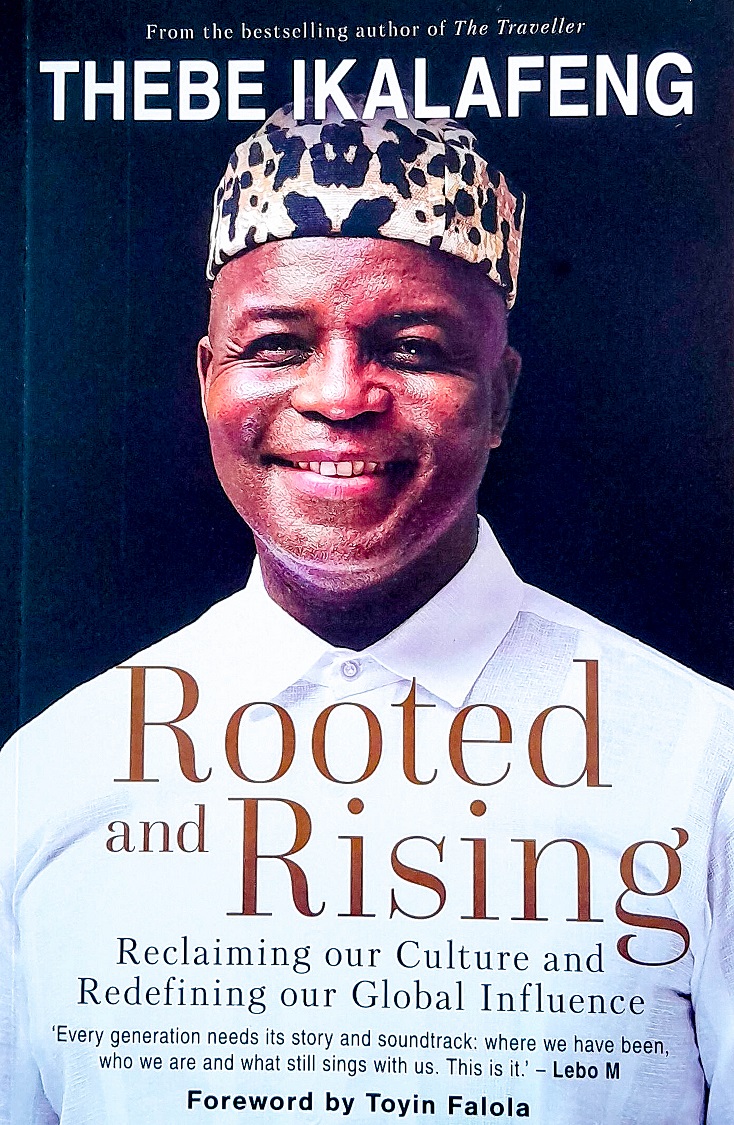
IN his newly-shelved tome, Rooted and Rising, globetrotting Kimberley-raised African branding exponent, Thebe Ikalafeng, volunteers his vision into readers’ confidence by reframing of reputation and brand building through pivoting on self-affirmation, ancestral alignment and cultural presence.
Through an African lens’ perspective, Ikalafeng shares a blueprint on how individuals can shape their journey sans losing their culture and heritage in the African and digital age. His is an analytical cross betwixt the African diaspora and western symbolism – intended as a personal reinvention manual.
Ikalafeng’s contribution packs clout considering that it is mostly gleaned from lived experiences – which include and involve his status as a leading advocate for a brand-led African renaissance – which per se elevates him to being an apt author to delve into the subject matter discussed in his tome.
And that he has crisscrossed, and continues to, the continent lends credibility to credentials as an authority on the subject under scrutiny.
It is, in a synopsis gleaned from a contributor of the tome’s foreword, a call to service for Africans who have drifted from their roots – in the aftermath of colonialism which distorted African history and left Black people forever dependent on Western measures of worth.
Indicative of his training and background as a marketer, Ikalafeng applies frameworks, diagrams, graphics, symbols, photographic imagery, et cetera – in elaboration of the plethora of points he puts across. Additionally, chapters are augmented by a musical playlist he collaborated on with composer Lebo M – which can be scanned from the tome’s pages – for a rounded reading experience.
Among topics discussed, Ikalafeng reveals his people-centred 7 Ps framework as the ‘key’ to achieving real advancement. Identified as: People, Pause, Purpose, Proof, Presentation, Presence, Protection – a breakdown of these is contained throughout subchapters of the tome and constitute thought-provoking insights.
Exemplifying the net worthiness of people, Ikalafeng invoked the familiar South African saying, “umuntu ngumuntu ngabantu” (a person is a person through others) further stating that the implication of such a saying is embedded in proverbs, moral codes and practices across the African continent.
Tracing along on his list, in his inspection of Purpose, the cultural champion mentions, inter alia, the historical stances taken by Muhammad Ali (who refused to be drafted for the Vietnam War at cost of being banned from boxing and a possible 5-year imprisonment term) and Nelson Mandela (who during a trial in which he faced a possible death sentence, defiantly declared his freedom fighting endeavour “. . . an ideal for which I am prepared to die.”) as examples of the ‘why’ of one’s existence.
On Proof, Ikalafeng offers a definition of the Tsonga saying, “mintirho ya vulavula” (deeds speak louder than words), as a juncture when competence meets performance – analysing on to reference the track record Rwandan president, Paul Kagame has been able to realize in 30 years, which had his country picking itself from the embers of genocide to becoming one of Africa’s fastest-growing economies.
Expounding on the matrix of competence and performance ensconced within this framework, Ikalafeng provides a table showing how African leaders and influencers rank – with him arbitrating the contributions of the ilk of erstwhile Liberian president Ellen Johnson Sirleaf, Africa’s wealthiest man Aliko Dangote, Zimbabwean tech whiz Strive Masiyiwa, et al., commendably.
Ikalafeng further acknowledges South African photographer Trevor Stuurman (whose list of achievements include being commissioned by the singer Beyoncé, BMW, etc., and being named in 2021 by Time magazine as a Next-Generation Leader, inter alia) – lauding him as reframing how Africa is seen through his lens.
A chapter about presentation reveals Ikalafeng’s divergent processing of others’ objections regarding African norms – with him delving into issues, from bodily aesthetics to dress codes, et cetera. He backs his assertions by providing backgrounds, histories and anecdotes qualifying how the various peoples across the continent came to identify themselves in the manner in which they have – with him being critical of Africans who pander to ‘western’ whims.
Among a plethora of instances he mentions, by manner of lending credence to his points, is the 2016 incident involving Black students of a Pretoria high school staging a concerted protest over the institution’s policy opposing hair styles such as Afros.
(The incident would propel a then 13-year-old Zulaikha Patel – whose activism was at the forefront of the saga – into the South African consciousness, resulting in no less a fellow activist than Angela Davis even travelling from the US to meet her.)
Further on, Ikalafeng brings to the reader’s attention, the juncture when Nelson Mandela began wearing his signature shirts and the initial derision others met his preference – with a National Party politician daring to utter that Madiba looked like a ‘coon’.
The author remembers that Mandela’s quiet rebellion survived on to become an accepted norm.
Filled with diverse facets, the author also touches on what nudity is for the various African tribes – as opposed to the taboo it is perceived to be as viewed through the eyes of others. Mentioning a juncture where an image featuring topless Himba women he’d posted on Instagram was promptly removed for “violating community guidelines”, Ikalafeng suggests that for Africans, the skin carries their story which informs others of their identity.
The tome culminates in a conclusion segment in which Ikalafeng wonders who is protecting Africans’ culture, and exhorts for a shift from personal branding to purpose branding – as well as a return home to their roots.
In putting forward his case, Ikalafeng had added this quote by Thomas Sankara: “We must learn to live the African way. It’s the only way to live in freedom and with dignity.”
Ikalafeng’s latest literary contribution is intended for unapologetic Africans ready to build an identity grounded in their culture and seeking to affirm their place in a diverse world while remaining rooted in their African heritage.
A soft cover, Rooted and Rising is published by Tafelberg.
Available at leading bookstores countrywide, it retails for R350.