HOPEFUL or not- that’s the reaction from the public following the tabling of the 2026 Budget Speech on Wednesday.
Government has withdrawn R20 billion in tax increases provisionally included in the 2025 budget, that caused tongue-wagging, and has adjusted personal income tax brackets and rebates for inflation, according to Finance Minister Enoch Godongwana, addressing the nation, in Cape Town.
The minister also adjusted personal income tax brackets for the first time in two years, bringing relief to salary earners.
He also announced sizeable social grant increases.
Government intends to spend R2.67 trillion in the 2026/27 financial year.
“The social wage accounts for more than 60% of non-interest spending over the medium term,” he outlined.
From April 2026, Social Grants will increase as follows:
- The old age grant, disability grant and care dependency grant rise by R80 in April 2026, to R2,400.
- The war veterans grant also increases by R80 to R2,420.
- The foster care grant goes up by R40 to R1,290 in April and by R10 to R1,300 in October.
- The child support grant and grant-in-aid grant increase by R20 to R580.
“Basic education, health and social protection constitute 70.3% of the social wage in 2026/27, providing support to 13.6 million school children, healthcare services to 84% of the population and social grants to 26.5 million beneficiaries.”
Sin taxes hikes:
- The tax on a 20-pack of cigarettes rises from R22.81 to R23.58.
- Pipe tobacco rises by 28 cents per 25 grams, and cigarette tobacco by 87 cents per 50 grams.
- Cigars rise by R4.56 per 23 grams.
- A 340 millilitre can of beer or cider increases by 8 cents.
- A 750-millilitre bottle of wine goes up by 15 cents.
- A 750-millilitre bottle of spirits will increase by R3.20
Godongwana also indicated:
- The general fuel levy will go up by 9 cents per litre for petrol and 8 cents per litre for diesel.
- The carbon fuel levy will go up by 5 cents per litre for petrol and 6 cents for diesel.
- The Road Accident Fund levy will increase by 7 cents per litre.
On Fiscal Outlook, the minister said, the consolidated budget deficit has narrowed to 4.5% of GDP for 2025/26 compared to the 4.8% estimated last year.
Treasury projects it to fall further to 4% in 2026/27 and 3.1% in 2027/28.
On Infrastructure
Public-sector spending on infrastructure will exceed R1 trillion over the medium term.
State-owned enterprises will spend R577.4 billion, provinces R217.8 billion and municipalities R205.7 billion.
As a share of GDP, gross debt has stabilised at 78.9% in 2025/26, with projections of 77.3% in 2026/27 and 76.5% by 2028/29.
The main budget primary surplus for 2025/26 has reached 0.9% of GDP, with further expansions of 1.6% (2026/27), 1.9% (2027/28) and 2.3% (2028/29) projected.
“We aim to introduce a proposal for a principle-based fiscal anchor in the Medium-Term Budget Policy Statement after thorough consultation in Cabinet, Parliament and with the public,” Godongwana said.
On tax relief measures, the minister indicated, higher VAT, corporate income tax and dividends tax collections have boosted 2025/26 gross tax revenues by R21.3 billion compared to the 2025 estimate, hence the withdrawal of R20bn in tax increases included in the 2025 budget.
To encourage South Africans to save more, Treasury has proposed that:
- The tax-free annual investment limit be increased from R36,000 to R46,000 per year.
- The limit to retirement fund deductions be raised from R350,000 to R430,000, allowing individuals to invest more each year on a tax-free basis.
For small businesses, Treasury has increased the compulsory VAT registration threshold from R1 million to R2.3 million.
It has also increased the capital gains tax exemption for the sale of a small business for older persons from R1.8 million to R2.7 million. This applies to small businesses worth R15 million instead of the previous R10 million.
Minister Godongwana also promised the issue of water challenges in the City of Joburg will be prioritised.
Political parties also weighed-in on the budget speech, with African Christian Democratic Party (ACDP) MP Steve Swart, describing the budget as hopeful.
He said high debt-service costs continue to crowd out spending on essential services such as education, healthcare and public safety.
Makashule Gana, Rise Mzansi MP, said one of the positive aspects of the budget was the decision to scale down, rather than abruptly terminate, the public transport network grant.
He said this approach gives municipalities time to plan for reduced funding and adjust accordingly.
Economic Freedom Fighters (EFF) leader Julius Malema criticised the budget for prioritising investor confidence over direct public infrastructure investment.
Malema argued that government should inject more funding into infrastructure and state capacity to create jobs, rather than, in his view, seeking to impress institutions such as the International Monetary Fund (IMF).
“We have to allocate more money in infrastructure and build state capacity,” he said, adding that young people should be prioritised in employment initiatives.
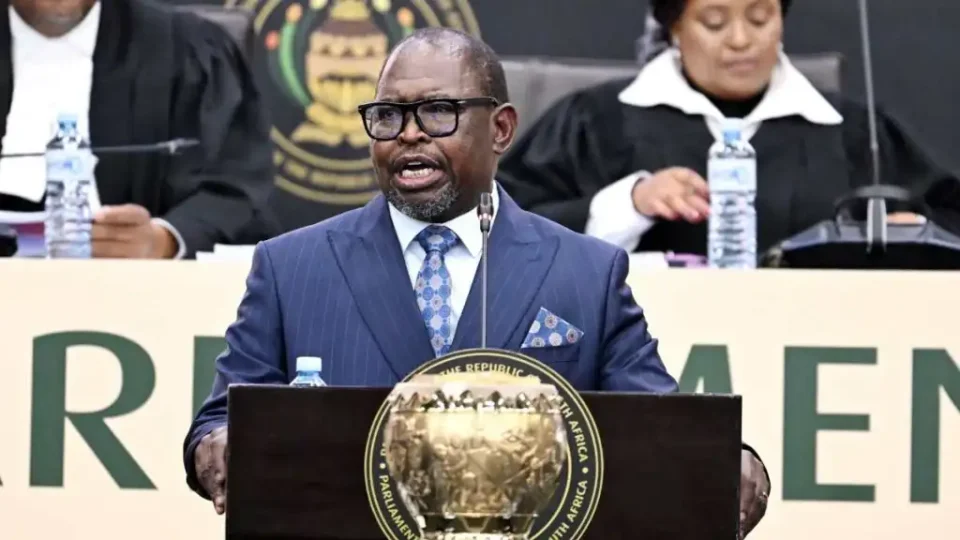
Image (Finance Minister Enoch Godongwana delivered ‘hopeful’ 2026 Budget in Cape Town, on Wednesday).