THE late internationally acclaimed photographer Santu Mofokeng’s legacy continues with the special screening of a documentary film about a part of his oeuvre at the Standard Bank Art Lab in Sandton.
Produced in 1996 by filmmaker Minky Schlesinger, it is punted as the only known filmed portrait of Mofokeng and offers audiences the opportunity to learn from the photographer about his relationship with photography, as well as the process involved in his oeuvre.
Initially made as part of Schlesinger’s series on stories of street photographers in the Joburg city centre – the documentary was first aired in 1996 on the SABC’s NNTV channel’s The Works weekly show. Schlesinger had learnt that Mofokeng had previously worked as a street photographer himself – which prompted her to include him in her documentary titled Street Shots.
Fourteen years after its debut, the documentary formed part of a major exhibition which showed in Belgium, France, Norway and Switzerland. Thereafter, sixteen years later, Lunetta Bartz – the co-curator of Mofokeng’s Rumours/2026 exhibition currently showing at the Standard Bank Art Lab – approached Schlesinger to showcase the film as part of the afore-mentioned exhibition.
Schlesinger’s film – which she refers to as ‘footage’ because it “isn’t a finished film”, according to her – is presented in an interview format in which she preferred Mofokeng to speak “in as unfiltered a way as possible.”
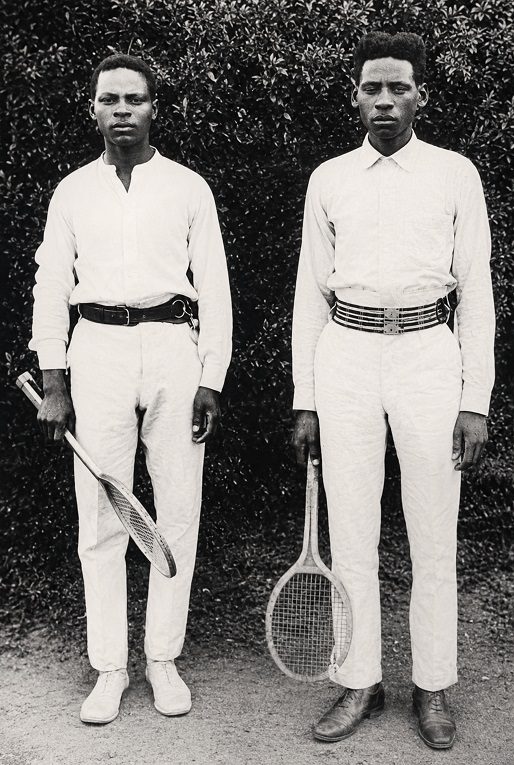
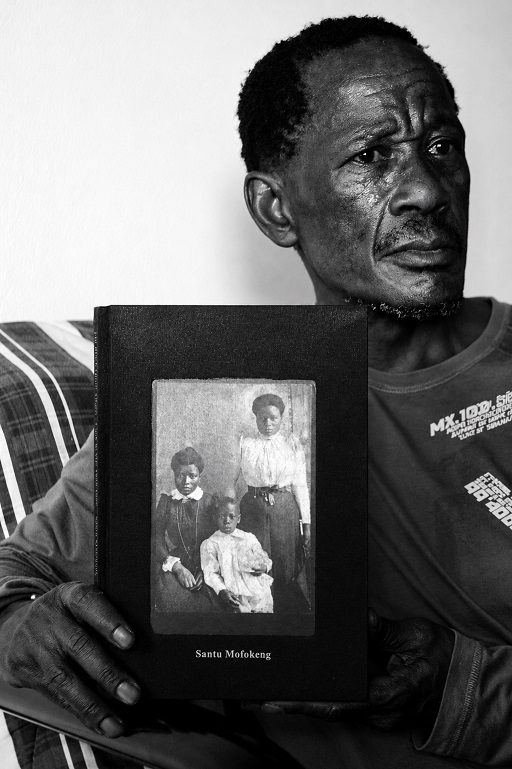
It mostly features the photographer expounding on the process of producing his body of work titled, The Black Photo Album/Look at Me: 1890-1950 – which forms part of Rumours/2026.
Recorded at Mofokeng’s darkroom and office at his abode, the film limns him speaking expansively and candidly about how he came about to collate The Black Photo Album/Look at Me: 1890-1950 visual project, which was commissioned by working and middle-class black families while he was a researcher at the African Studies Institute at the University of the Witwatersrand.
In the film, Mofokeng takes the viewer through the process involved: from having discovered old family album photographs in boxes to making negative film copies of those and thereafter storing captions onto a computer.
Because the images – which are mostly studio portraits a la Malian photographers, Seydou Keita and Malick Sidibe’s portfolios – existed outside of official archives, they presented a challenge for Mofokeng in his attempts to trace their origins or relatives of the subjects thereon.
In addition to the compilation of black family snaps, Schlesinger’s documentary also briefly delves into Mofokeng’s renowned Chasing Shadows series on spirituality such as the segment he recorded at Motouleng caves at Clarens in the Free State province.
Describing the act of photographing as “taking someone’s spirit”, somewhere in the tete-a-tete interview with the filmmaker, Mofokeng deadpans that “photographs don’t tell the truth.” Rounding off by qualifying his assertion thus: “they can be manipulated by captions.”
At the film’s special screening – which was attended by some of Mofokeng’s family members – Schlesinger mentioned that she hoped to also present a 2013 footage (which she describes as hard to watch because Mofokeng had by then become frail) she produced about the photographer, so that “Santu can continue his conversation with you, his audience.”
About Santu Mofokeng
Santu Mofokeng was a news and documentary photographer who was a member of the Afrapix collective of South African documentary photographers throughout the tumultuous 1980s.
A former student of the late photographer David Goldblatt, Mofokeng worked as a photographic researcher for the African Studies Institute at the University of the Witwatersrand, and became an early exponent of research-based photographic practice in South Africa through which his work avoided the sensational reportage style of news media – for which he briefly worked as a photojournalist with the New Nation newspaper – to provide an intimate vision of South African communities.
Widely regarded as one of the most influential African photographers, Mofokeng was the recipient of numerous awards which, inter alia, included: the Ernest Cole Scholarship to study at the International Centre for Photography in New York in 1991; the first Mother Jones Award for Africa in 1992; the Prince Claus Award in 2009; and the International Photography Prize in 2016.
Mofokeng passed on in January of 2020, succumbing to what has been described as progressive supranuclear palsy.
About Minky Schlesinger
Minky Schlesinger is an award-winning writer/director best known for the television series, uGugu no Andile; Home Affairs and 4Play: Sex Tips for Girls – among a plethora of productions.
In 2013, Schlesinger went back to interview Santu Mofokeng for a documentary titled Second Sight – which explores the profound impact of photography, through the lens of five acclaimed South African photographers (who include Mofokeng).
Image Jacob MAWELA (Santu Mofokeng limned posing with his book, The Black Photo Album at his abode in Bezuidenhout Valley in January 2014.)