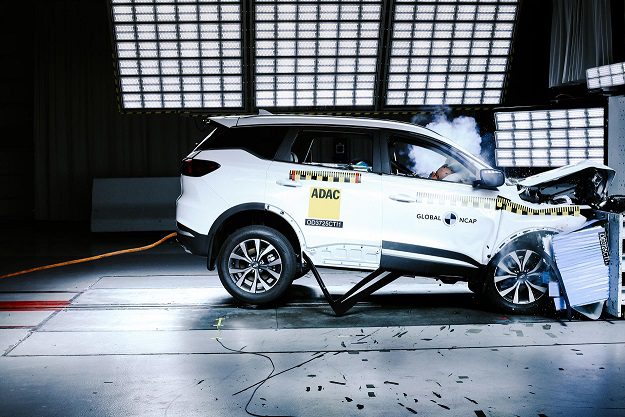
THE Automobile Association of South Africa (“AA”) notes the publication of the Draft Compulsory Specification (VC 8022/24 in Government Gazette No. 54970), issued on 10 July 2026, which allows for public commentary (within two months of publication) re the revision of the minimum safety standards for all new passenger cars sold locally.
The AA insists that these standards be applied and implemented across all derivatives and spec levels sold in South Africa.
The AA welcomes the gazetting of the updated airbag requirement below, a result of the campaigning the AA has undertaken for many years now under the banner of #SaferCarsForAfrica.
Airbag protection for all occupants will lead to safer cars, especially in the entry-level space which the AA has observed as the cost-point at which local manufacturers and distributors tick as few safety boxes as possible. The AA requires side and curtain airbag protection for consumers.
Should the minimum be four airbags, the AA mandates that curtain protection be part of the functionality of the additional airbag installation.
3.9 Requirements for airbags
3.9.2 A vehicle shall be fitted with airbags that are:
Intended to protect all occupants other than the driver and comply with the requirements given in UNECE R94.03 – Uniform provisions concerning the approval of vehicles with regard to the protection of occupants in the event of a frontal collision
The AA also takes note of the highlighting of Side impact protection as a mandatory requirement and welcomes this as a further passenger-protection inclusion item. Side impact vulnerability has been repeatedly cited as a concern in the AA’s #SaferCarsForAfrica program, with the Association lobbying for decades for better Side impact protection on cars sold in South Africa.
3.6.1 Side impact
The protection of occupants of the vehicle in a side impact collision shall comply with the requirements given in SANS 20095: 2017 Edition 1 – Uniform provisions concerning the approval of vehicles with regard to the protection of occupants in the event of a lateral collision
We further welcome the inclusion of Electronic Stability Control (“ESC”) within the proposed safety requirements and stipulate that ESC be made mandatory across all specification levels of newly introduced vehicles locally. Electronic Stability Control is a key component of vehicle safety and stability and has been widely recognised as an important technology in reducing the risk and severity of certain crashes.
3.4.1.1 For the purposes of electronic stability control (ESC) only, compliance to UNECE R140.00 – Uniform provisions concerning the approval of passenger cars with regard to Electronic Stability Control (ESC) Systems is accepted.
Once these standards are gazetted, it is worth noting that manufacturers will have six months to ensure that all cars introduced and sold in South Africa, irrespective of specification level, adhere to these revised safety standards.
As the Automobile Association, we view this as the culmination of decades of fighting for consumer safety in the mobility space.
These amendments will contribute to improved NCAP vehicle safety ratings, bringing South Africa more closely into alignment with other markets which for years have insisted on these basic safety requirements.
We trust that these comments will be noted and duly considered and look forward to the gazetting of legislation that will ensure local manufacturers and distributors are held appropriately accountable for meeting these safety requirements.