
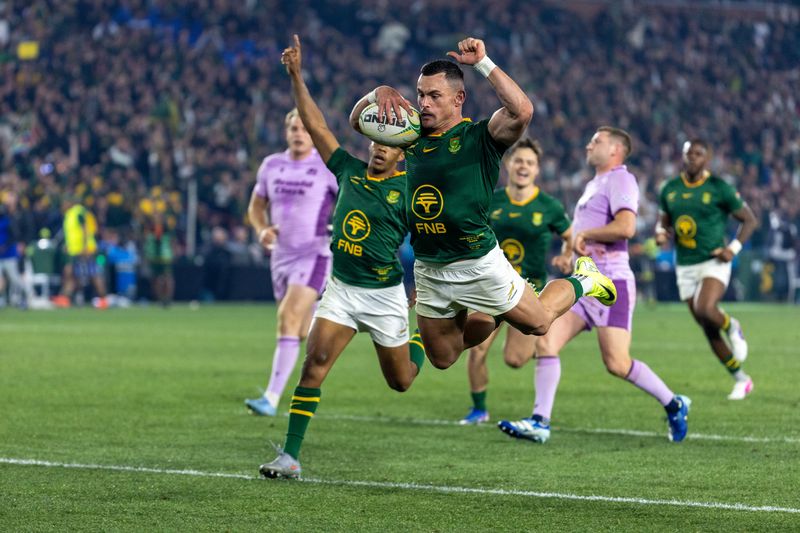
A MUCH-changed Springbok team came through a see-sawing slugfest with Scotland to produce a 42-28 victory (halftime 14-14) in an inaugural Nations Championship match at Loftus Versfeld on Saturday.
The Boks prevailed by six tries to four after making 10 changes to the starting XV that had beaten England 45-21 seven days ago.
It kept South Africa on top of the Southern Hemisphere conference on points difference from New Zealand. Both teams have a maximum of 10 log points.
“It’s much nicer when you win and you learn than when you lose and you learn,” said Erasmus.
“There was a stage in 2018 when we were learning but we were losing – but it was important to find out who can do it at this level and who needs some work.”
The Boks scored two tries in two minutes in the first half to spring into a 14-0 lead and then scored another three in eight second half minutes to take a 21-point lead (35-14) at one stage, but each time Scotland hit back with tries in quick succession of their own.
“We had 12 guys who each had less than 10 caps – half the team – so we knew cohesion was going to be a problem,” said Erasmus.
“That you could see in the defence when we made some subs at the end. We learned a lot about some players – not that they are not good enough – but that there’s a lot of work to be done.
“This is the test that some of the guys needed – not against a tier two nation; but against a tier one nation that’s a really class team.”
Erasmus admitted that it had been a risk, but said he believed that the South African rugby public understood what the team was trying to do.
“I don’t think the crowd was happy at the end, but I think South Africa understands what we tried to do in this game,” he said.
“In the past I felt if we made four changes people would ask ‘what are you doing?’ But I feel the interaction between us and the supporters – through the media – gives us a togetherness and people know what we are trying to do. I think that’s something that’s changed over the years.
“It’s the crowd believing in the team and the team believing in South Africa, because they could easily have gone against us with those easy tries we gave away, but there’s a few players who haven’t done it at this level.
“If we lose the knives will be out – but for me the most important thing is learning about the players. If we had lost this game, I think there would be some of the crowd who would understand what we tried to do – but luckily we won.”
Erasmus’s said that the lessons learned had been worth the changes: “Sometimes we must put our personal goals to one side of how many games you’ve won in a row or even putting winning this championship on the line so that you can know who can do what.
“If you don’t make those calls you would never know. When do you do it? Are you always going to do it when you play a team that’s not of this calibre – because I think they are a great team. That’s how you find out.
“It’s tense, there’s pressure, there’s a crowd who’ve bought tickets because they want to watch this game – they don’t even know the players so well because they’re not even settled test match players!
“So, for those guys to feel the crowd going quiet when it’s not going so well. That’s the only way we can ever learn. I’m not saying this to make out performance sound better – and I don’t want to upset the English – but we thought they were going to be tougher than England.
“The way they smashed Argentina, the way they beat England, the way they beat France and were playing just four months ago in the Six Nations, we knew it was going to be a really tough game.”
The Springboks complete the July leg of the Nations Championship against Wales at Hollywoodbets Kings Park on Saturday.
Image provided (Boks wonderboy Jesse Kriel recorded scoring a try against Scotland at the Loftus Stadium, last Saturday.)
Meanwhile, SA Rugby said on Monday that its ticketing strategy would be thoroughly reviewed at the end of the 2026 season, while thanking fans for their continued support during the inaugural Nations Championship.
Mark Alexander, president of the South African Rugby Union, said SA Rugby had noted concerns about ticket pricing and recognised that some categories needed careful review and revision: “We take full ownership of this matter and are committed to ensuring that our ticketing structure reflects accessibility and sustainability.
“Supporters’ passion and loyalty are central to our success, and we are deeply grateful for their commitment to our teams. Rugby is a shared national treasure, and we have a responsibility to ensure every supporter feels part of the journey.
“At the same time, we must balance this commitment with the responsibility of making these events financially viable. It is a delicate balance, but one we are determined to manage responsibly,” said Alexander.
SA Rugby recorded a loss in 2025, making allegations of “greed” over ticket pricing unfounded, said Alexander.
“Our commercial strategies are designed to cover the cost of running rugby in South Africa, not to increase profits,” he said.
“Springbok Test matches create a major economic impact, both direct and indirect, contributing to the broader economy while further promoting our country on the global stage.
“Rugby is not only a sport but also a powerful driver of national pride and international recognition.
“Our objective is clear: to balance the financial sustainability of the sport with the imperative of keeping rugby accessible to all South Africans.
“Accordingly, SA Rugby will review our ticketing framework for the 2027 season and beyond and we will implement the necessary adjustments to ensure that our approach remains both sustainable and supporter‑focused.”