MEMBERS of the Fourth Estate, civil society, academics, policy makers and the public gathered over three days of insightful sessions featuring inspiring speakers and in honour of Black Wednesday at the Goethe-Institut in Parkwood, Johannesburg from 14 to 16 October – for the 2026 iteration of Media Freedom Festival.
With this year being the festival’s ninth year, it was described as a cornerstone of South Africa’s information ecosystem as well as a platform for dialogue, collaboration and advocacy which has brought together the afore-mentioned stakeholders for the past eight years.
In an era of AI and disinformation, the rendezvous – held under the theme ‘Elections and Accountability: News, Digital Media and Information Integrity’ – occurred just ahead of the November 4 Local Government polls amidst an environment in which feuds over what voters see, share and believe have already commenced.
The festival was jam-packed with thought-provoking colloquiums, hands-on workshops, masterclasses quickfire inputs, Quiz Nights and an interactive Rate the Hate Gameshow and live challenge on the limits of free speech curated through a programme held in the main hall, seminar room, library and classrooms of the venue – which is a cultural institute of the Federal Republic of Germany.
The rendezvous also witnessed the launch of three new handbooks by host entity Moxii Africa, meant to equip the judiciary and the police to navigate online harms and cyber crimes ranging from extortion to non-consensual intimate image sharing.
Speakers included international intellectuals such as German scholar and journalist Dr Christopher Nehring, South African Human Rights Commission’s Commissioner Nomahlubi Khwinana, the IEC’s Communication General Manager Fikile Moya, Konrad-Adenauer-Stiftung’s Regional Media Programme for Sub-Saharan Africa Executive Director Hendrik Sittig and UNESCO Chair in Cultural Inclusivity and Equity in Digital Media in Africa Professor Prinola Govenden – et al.
That cohort was complemented by a stellar cast of international Fourth Estate practitioners such as Die Zeit news publication’s Cornelius Pollmer, EyeWitness News reporter Kgomotso Modise, SABC newsreader-reporter Liezle Wilson, ex-editor-in-chief of the Mail & Guardian Verashni Pillay, South African National Editor’s Forum Projects and Office Manager Hopewell Radebe and the University of Johannesburg’s PhD candidate in Journalism Willard Mapfumo, et al.
Day 1, which dealt with Incitement, Online Harms and Elections, was compered and moderated by SABC broadcaster Liezle Wilson and featured participants ranging from the Embassy of Germany’s Camilla Christie, the UNHCR’s Katie Drew and Die Zeit’s Cornelius Pollmer, among others.
Dr Christopher Nehring, who is the director of the Cyberintelligence Institute in Frankfurt am Main and whose areas of expertise are disinformation and security journalism – delivered input on information manipulation in the age of AI. Other speakers from across the globe representing international entities tackled issues ranging from freedom of expression to others and harm – among a diversity of topics.
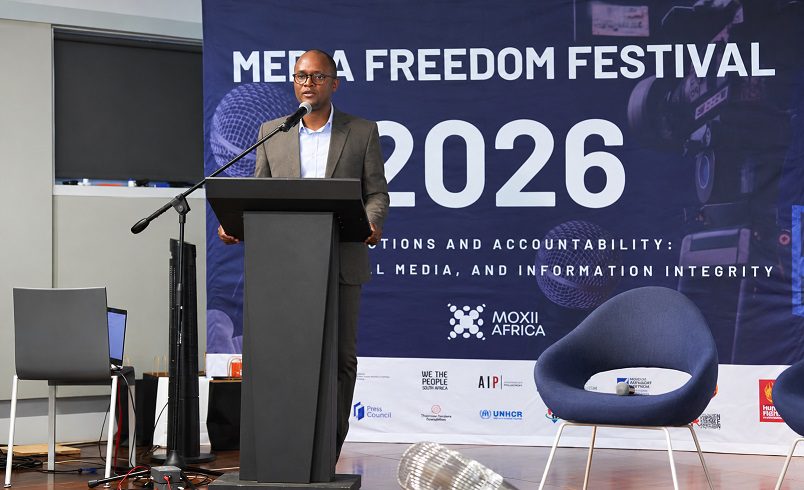
South Africa’s Minister of Communications and Digital Technologies, Solly Malatsi delivered a keynote address on protecting information integrity on Day 3 of the colloquium in which he expressed hope that discussions over the three days of the festival would lead to decisive action, a more informed public and stronger integrity in the run-up to the local government elections.
Said Malatsi, “Gatherings such as these have grown even more important with the rapid development of digital technology such as artificial intelligence (AI) and increasing threats against democracy.
These elections are likely the most contested polls for our democracy. Indications are that many councils will be led through coalition governance.”
“Propaganda, rumours and misinformation have been features of politics ever since people started contesting for power. But in recent times, fake news, bots, nefarious actors using digital advertising and disinformation have emerged as serious threats to the integrity and credibility of elections,” the minister continued.
Malatsi further pointed out to the use of AI to fake voice notes or to create life-like videos and social media disinformation capable of spreading like wildfire – resulting in influencing people who may not have the know-how to analyse a message for its credibility.
“But the reality is the fact-check post or statement never travels as fast and as wide as the lie it seeks to fight, especially when recommendation systems and algorithms reward whatever keeps us scrolling. This is an area in which the social media platforms have to do more,” Malatsi added.
Continued the minister, “To fight disinformation we need an informed citizenry with the right digital skills, the right government policies, effective regulators such as the Film and Publications Board (FPB), committed truth-tellers – such as our media fraternity and bodies like Moxii Africa – and platforms with strong moderating systems.”
Mentioning that access to information is the basis of freedom of expression, Malatsi further enquired what the role of the state was – promptly responding by expounding on four points: first, the state must be a reliable and affordable source of information in its own right; second, we must ensure there is sufficient protection for journalists, community media, fact-checkers and whistleblowers; third, the legislation government already have must work together, instead of lacking coordination and enforcement; fourth, government, the private sector and civil society must invest in digital skills training to equip people with the tools to make informed judgement.
“The Electoral Commission, the Information Regulator, the FPB, the Independent Communications Authority of South Africa, the Human Rights Commission and the Press Council cannot each hold one piece of a puzzle which never comes together.
This is one of the limitations we aim to resolve with strengthened audio and audio-visual policy,”Malatsi explained.
Pressing his points further, he added, “Media and information literacy is the first line of defence, and offers the quickest action step against disinformation. Training people won’t just allow them to spot fake news, it will teach them how to take action and flag scams, disinformation and lies. Our efforts in this regard already start at primary school level.”
“We are also obligated to use the digital tools at our fingertips responsible and for good. AI, for example, is a useful tool, and one that is transforming the way we work. But – and I know this all too well with the withdrawal of the draft AI policy – it is not a substitute for human responsibility and fact-checking. In closing, I want to say that information integrity is a matter of shared national interest. Technology is not destiny.
Our choices are. Let us make good ones,” Malatsi concluded.
Subsequent to the minister’s address, Wilson fielded a Q & A between him and members of the audience, and that was followed by a Quickfire Input session at which a panel comprising of – et al. – Auxo Digital’s Njabulo Mthombeni and the SOS Coalition’s Uyanda Siyotula dug into issues shaping media and democracy.
The co-founder of the South African digital agency which builds AI-enabled software platforms, Mthombeni pointed out that South African newsrooms were adopting AI, stating that, “media researchers need technologies in their ecosystem.
Siyotula in the other seat, brought attention to the SABC’s obligation in being the source of information for people who don’t have the means and access to commercial platforms.
The festival concluded on a Friday evening with the Reporters Slam at the Wits Theatre, where journalists who included EWN’s Kgomotso Modise, the Sowetan’s Herman Moloi, and Die Zeit’s Cornelius Pollmer among others staged 7-minute live performances of the stories behind their reporting – with the audience deciding the winner.
The festival was hosted under the auspices of Moxii Africa, an independent entity which over 30 years has been defending the right to credible, transparent information.
It occurred just three days before the 49th anniversary of Black Wednesday – a dark day in apartheid history when the state launched a massive crackdown on anti-apartheid voices which included the independent media, on October 19, 1977.
Media Freedom Festival 2026 was made possible with the support of seventeen partner organisations who, et al. included the Embassy of the Federal Republic of Germany, Konrad-Adenauer-Stiftung Regional Media Programme Sub-Saharan Africa, Thomas Reuters Foundation, WITS Centre for Journalism, UNESCO, Amnesty International South Africa, Campaign for Free Expression and the Press Council.
Image Jacob MAWELA (Minister of Communications and Digital Technologies Solly Malatsi limned addressing attendees at the Media Freedom Festival 2026 at the Goethe-Institut in Parkwood.)