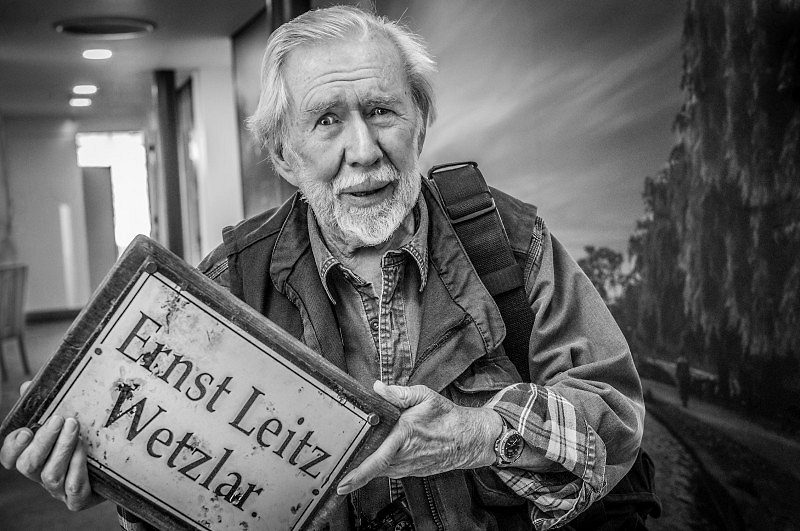
THE sole photojournalist who captured the Sharpeville Massacre on March 21, 1960, Ian Berry passed away at the age of 92 on September 13, 2026.
Berry was a staff photographer on Drum magazine when through his cameras, he witnessed the fateful incident which went down as one of infamy in South Africa’s chequered history.
At the time Berry, a British citizen who had arrived in Johannesburg to seek new adventures, had been requested to travel to the then Vaal Triangle location on his day off, to cover occurrences around pass laws protests.
Berry had arrived with a sub-editor colleague in the area and made a conscious decision – probably from sensing that something was in the offing – to hang around despite a police officer dissuading them and an international media corps to vacate the area under threat of arrest.
“You better get the hell out of here, or you’ll be arrested,” Berry recalled the officer threatening.
On the Magnum agency (the hallowed photographic agency whose co-founder, Henri Cartier-Bresson, subsequently invite him to join) website, Berry described the calm before the storm which erupted around a police station when police opened fired on a crowd of about 7000 demonstrators thus: “We came to the police station which was a building surrounded by wire with a large compound front.”
“I walked into the crowd, who were all pressed up against the wire, and chatted with them; they were all friendly. Nothing was happening …. Just as I walked beyond the car I looked back at the police station – you know the final check that you always do before you leave – and the shooting started,” he expounded.
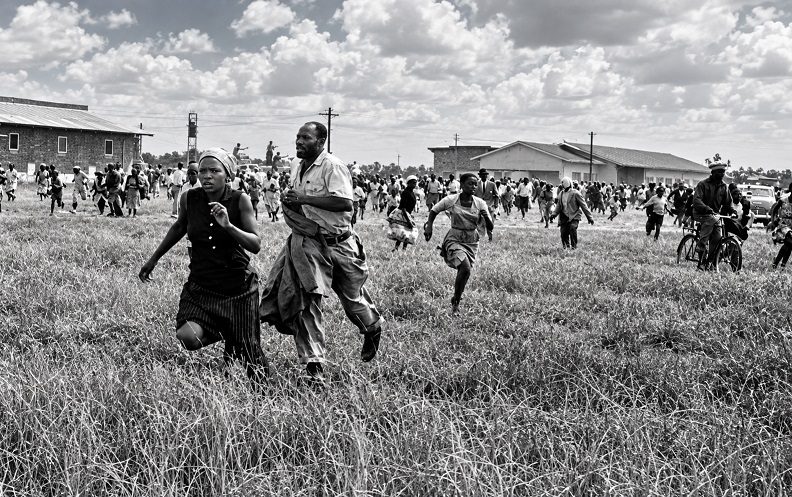
“I thought at first that they were either firing blanks or they were firing over people’s heads to disperse them,” he said. “It was only when a woman who was standing next to me fell on the ground that I realised they were actually shooting bullets. I, myself, got down on the ground quickly and shot the crowd running away in every direction.”
“When the shooting stopped, I was the only person still standing in the field. I thought this was not a good plan because the cops had offered to shoot me in the past as a photographer. I ran back to the car and we took off,” recalled Berry who, as a white at the time, was required to carry a permit to be in a black area.
South African police had opened fire on the crowd, killing, it would transpire, 69 people, with 289 casualties in total, including 29 children. Many of those injured sustained back injuries from being shot from behind as they tried to flee.
“From my point of view the only good thing that came out of this was that as the only non-police white guy to witness the people running away who were shot in the back, I was able to testify when they were charged with affray and it came to court. I was called to give evidence and as a white in those days in South Africa my word was taken as gospel. I was believed over the police,” Berry mentioned.
In an 2013 interview with Vice magazine, Berry had been asked how he landed up in South Africa in the first instance – to which he responded that as a young Brit who sought travel, the country (whose status as a member of the Commonwealth ensured that he’d be granted assisted passage) sounded as the most exciting destination in his equation.
“I thought I’d be seeing lions on the streets of Johannesburg,” he quipped.
Excerpts from an obituary by the premium photography publication, Leica Fotografie International (LFI) mention Berry as having never received formal training in photography – instead, starting out as an amateur photographer aged 18 when he left England for South Africa.
As an expat, he would gain perspective on apartheid society which was both more analytical and more emphatic than that of many white photographers. Even after his return to Europe, Berry continued to document developments in South Africa and the gradual fall of apartheid, during extended visits.
Right up to his very last photographs, Berry was described as “selfless, understated, always present but never visible – a ghost with a clicking Leica”, as aptly characterised by his Magnum colleague Philip Jones Griffiths.
Image Frank Dabba Smith (Ian Berry’s image limning people fleeing police shooting pending the Sharpeville Massacre.)